
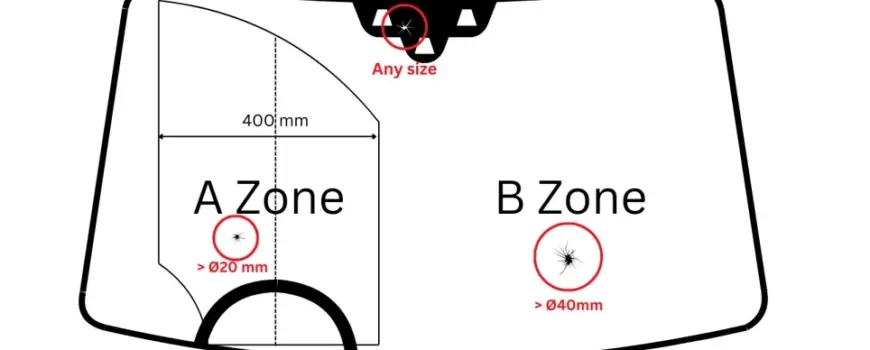
If your windscreen has a chip, the choice between repair and replacement depends on size, location, and severity. Small, clean chips can usually be repaired quickly and cheaply, while cracks near the driver’s line of sight or glass edge almost always require full replacement for safety and clarity.
Chip Repair vs Windscreen Replacement
When Chip Repair Works
- Size: Chip is R2 coin or smaller.
- Location: Not in the driver’s A-zone (direct line of sight).
- Condition: Away from the edge, not spread, and preferably fresh (no dust/moisture).
- Time: Takes 30–40 minutes.
- Cost: Often covered by insurance with little or no excess.
- Environmental benefit: Avoids unnecessary glass waste.
When Windscreen Replacement Is Needed
- Damage in the A-zone or near the edge.
- Long cracks, branching cracks, multiple chips, or deep impacts.
- Older, contaminated chips that won’t clear optically.
- If visibility remains distorted after repair.
- Vehicles with ADAS sensors/cameras (lane keeping, AEB) often require recalibration after replacement.
- Time: 1.5–3 hours including calibration.
- Cost: Higher, excess may apply.
⚖️ Quick Comparison
| Factor | Chip Repair | Windscreen Replacement |
|---|---|---|
| Cost | Lower, often excess-free | Higher, excess may apply |
| Time on site | 30–40 minutes | 1.5–3 hours + calibration |
| ADAS impact | Not affected | Recalibration required |
| Environment | No new glass | New glass needed |
| Best for | Small, clean, stable chip | A-zone, edge, deep or multiple chips |
Why Repair First?
- Cost savings: A fraction of replacement cost.
- Insurance-friendly: Many South African insurers favour chip repair.
- Convenience: Quick mobile service at home/office.
- Eco-conscious: Prevents landfill waste and reduces emissions.
When Replacement Is Safer
- Chips near the edge can spread due to stress and vibration.
- Deep or multiple cracks compromise structural integrity.
- Optical clarity: Repairs may leave faint marks; replacement restores full visibility.
- ADAS recalibration: Ensures lane keeping and emergency braking systems remain accurate.
Practical Tips
- Repair early: Fresh chips give the best results.
- Don’t delay: Temperature swings can turn chips into cracks.
- Side/rear glass: Cannot be repaired — must be replaced.
- Safe Drive Away Time: Technicians advise when adhesives are fully cured.
Next Steps
- Book a fitment or chip repair: 0861 694 527
- Online booking: myglass.co.za/book
- Have your policy number, VIN, and photos ready for quick assessment.
👉 Bottom line: If the chip is small, clean, and away from critical zones, repair is faster, cheaper, and eco-friendly. But for cracks near the driver’s view, edges, or with ADAS systems, replacement is the safer choice.
Would you like me to condense this into a customer-facing flyer version (short, visual, and easy to scan), or keep it as a detailed article rewrite for your blog?